
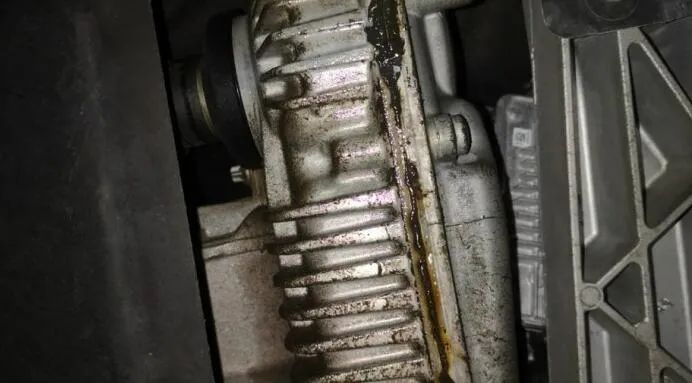

Fault Description:
2015 BMW X3 recently discovered a significant oil leak from the transfer case during routine maintenance. The leak has even spread to the transmission area.
Diagnosis Process:
First, understanding the structure and working principle of the transfer case helps us better comprehend the causes of oil leaks. BMW's transfer case uses a multiplate clutch to achieve fulltime power distribution between the front and rear axles. The contact between these clutch plates is inevitable, and in order to efficiently transfer power, the plates must slide against each other. This sliding generates friction, which in turn creates high temperatures. These high temperatures put considerable stress on the seals inside the transfer case. Therefore, over time, the oil seals in the transfer case may become worn, damaged, or degraded.
While highmileage vehicles (e.g., those with over 100,000 km) are more prone to oil leaks, some newer BMW Xseries vehicles may experience oil leaks after just 20,000 to 30,000 km. This is typically due to quality control issues or manufacturing defects.
Common Causes of Oil Leaks:
-
Aging and Damage to Oil Seals
For BMW X3 vehicles with higher mileage, the primary cause of oil leaks is usually the aging or damage of the oil seals. In this case, simply replacing the damaged seals with new ones will resolve the issue. -
Manufacturing Defects or Technical Bulletins
For newer BMW X3s, oil leaks may be caused by factoryinstalled oil seals that do not meet the required standards, or due to design issues mentioned in technical bulletins, such as problems with the radial seal (RWDR seal) or poor sealing of the ventilation system.
Diagnosis Process
First, understanding the structure and working principle of the transfer case helps us better comprehend the causes of oil leaks. BMW's transfer case uses a multiplate clutch to achieve fulltime power distribution between the front and rear axles. The contact between these clutch plates is inevitable, and in order to efficiently transfer power, the plates must slide against each other. This sliding generates friction, which in turn creates high temperatures. These high temperatures put considerable stress on the seals inside the transfer case. Therefore, over time, the oil seals in the transfer case may become worn, damaged, or degraded.
While highmileage vehicles (e.g., those with over 100,000 km) are more prone to oil leaks, some newer BMW Xseries vehicles may experience oil leaks after just 20,000 to 30,000 km. This is typically due to quality control issues or manufacturing defects.
Common Causes of Oil Leaks:
-
Aging and Damage to Oil Seals
For BMW X3 vehicles with higher mileage, the primary cause of oil leaks is usually the aging or damage of the oil seals. In this case, simply replacing the damaged seals with new ones will resolve the issue. -
Manufacturing Defects or Technical Bulletins
For newer BMW X3s, oil leaks may be caused by factoryinstalled oil seals that do not meet the required standards, or due to design issues mentioned in technical bulletins, such as problems with the radial seal (RWDR seal) or poor sealing of the ventilation system.

Transfer Case Repair Solutions
Depending on the cause of the issue, the methods for addressing a transfer case oil leak in a BMW vary. Below are several common causes of oil leaks and their corresponding solutions:
-
Replace the Oil Seal
For aging oil seals, the most common solution is to replace them with new ones. For BMW X3 vehicles that have been in use for a long time, this is the most straightforward and effective approach. -
Factory Oil Seals Not Up to Standard
If the oil leak occurs in a new vehicle, it could be due to the original transfer case oil seals not meeting the required standards. In this case, the solution is to replace them with seals that meet the correct specifications. -
Radial Seal (RWDR Seal) or Ventilation System Sealing Issues
If the oil leak is caused by poor sealing of the radial seal or the ventilation system, the following actions may be required:
◦ Check if there are oil traces on the ventilation pipes. If oil traces are found and the upper part of the transmission control unit is dirty, the ventilation pipe should be replaced or a fixing clamp should be installed.
◦ If the leak primarily comes from the rear output shaft oil seal and the ventilation pipe is dry, the rear output oil seal should be replaced.
◦ If the leak mainly comes from the front half of the transfer case housing, and the inspection hole between the transfer case and transmission is clean, the front output shaft oil seal should be replaced.
◦ If the inspection hole is contaminated with oil, it indicates that the oil seals at the transmission output end or the transfer case input end are not sealing properly. In this case, the corresponding oil seals should be replaced. -
Transfer Case Housing or Bolt Leaks
If the oil leak is coming from the housing or bolts of the transfer case, follow these steps:
◦ First, clean any existing oil residue.
◦ Drive the vehicle for a few hundred kilometers to confirm if the leak is coming from the housing or bolts.
◦ If the leak is confirmed, apply silicone sealant to the housing joint and also apply sealant to the bolts during retightening.
Conclusion
Transfer case oil leaks are a relatively common issue in the BMW X3, with the primary causes being aging oil seals, manufacturing defects in the original seals, or poor sealing of the radial seal and ventilation system. For older vehicles, regularly checking and replacing the oil seals is an effective way to prevent leaks. For newer vehicles, it is important to check for any manufacturing defects or issues addressed in technical bulletins. Timely inspection and repair can effectively resolve the oil leak problem, prevent further damage, and ensure the vehicle's safety and stability.
If you encounter repair issues with your BMW or any other vehicle, feel free to share your thoughts and experiences with us. We are always here to provide professional answers and assistance!
Share:
Volkswagen Unable to start (gauge shows put selector lever in P/N position!) Failure Case
Troubleshooting Turbo Boost Issues: Oil Leakage in BMW Engines