
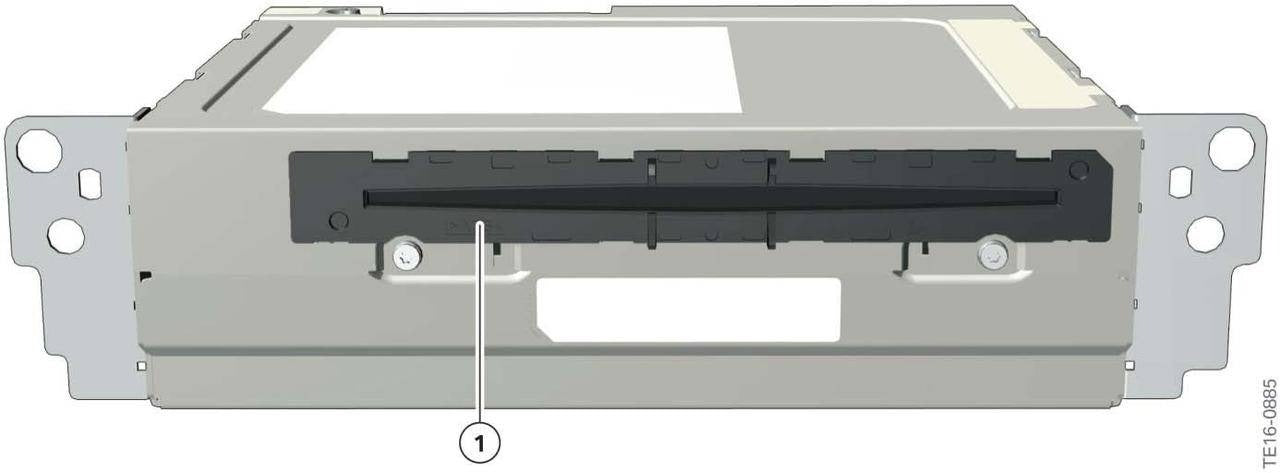
1.MGU Architecture Headunit (Headunit)
BMW's newgeneration electronic architecture began to be designed in early 2016, and was officially massproduced in September 2018, making extensive use of Ethernet and domain controllers. Among them, we are familiar with the MGU (Media Graphics Unit), which is actually the fifth generation of BMW's cockpit electronic architecture, and its Headunit (host computer) BMW's internal code name is HUH3 (corresponding to the id7 system). In BMW's socalled evo host, BMW also has two hosts, whose internal code is HUH2 and HUB2 (corresponding to id6 system), of which HUH2 is Professional navigation system (SA 609) “configuration of the host (Harman and BAUER), and HUB2 is Professional radio (standard configuration with 8G flash memory) or as a main unit (hifi) in Business navigation system (SA606 with 32G flash memory) configuration.
Speaking of which, is it clear that BMW enthusiasts are still complaining about BMW's simplicity? BMW's id7 system of the host of the whole system is HUH3, which is BMW's new audio system design decision, the back will slowly unfold, so it is very conscientious.
This is a diagram of the BMW HUH3 system, and it's clear to see that BMW has stripped out the audio processing part of the mainframe, and it's handled by a separate ram, so it doesn't matter if it's a hifi, a Harman or a BAUER, you can use the same mainframe.

This is BMW's HUB2 system diagram, compared to the above diagram can be seen, it is by the host builtin amplifier to directly promote the speakers, while the high end of the Harman and BAUER is by most fiber optic signals to the amplifier for processing. Of course, this host is also reserved most fiber optic interface.
Here you may be confused, you get such a picture, see my good dizzy ah, the next point of the physical picture.

This is the back of the HUH3 mainframe, comparing to the HUB2 mainframe, there is mainly less FM/AM antenna and amplifier output port, and one more dedicated Ethernet port (port 8). Well, an obvious comparison, you can see that the HUH3 mainframe does not have an amplifier output function, BMW's new architecture has inherited this part of the function along with the AM/FM function into the RAM module.
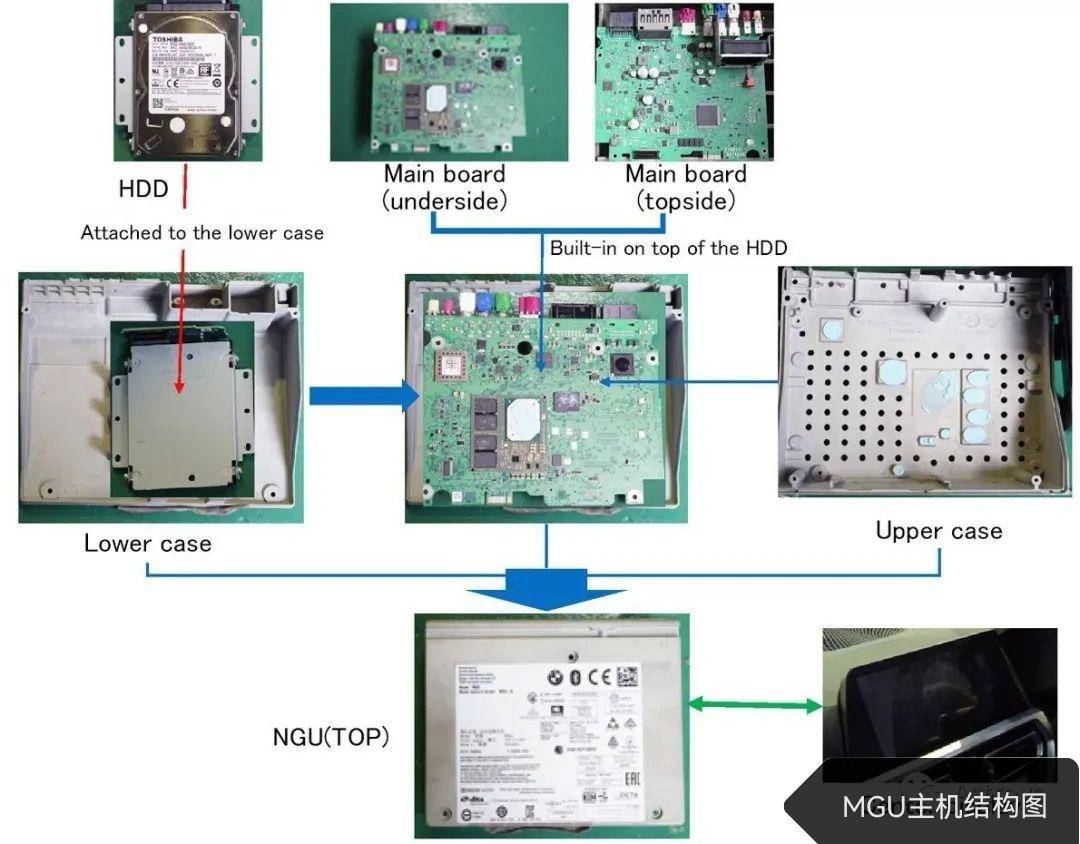
The following disassembles the HUH3 mainframe.
The MGU architecture was designed in early 2016, so it still uses a mechanical hard disk (HDD) for primary storage, with 320GB of hard disk capacity, of which 160GB is for navigation, 34GB for entertainment, 16GB for networked music, and 34GB of usable space. the HDD is underneath the mainframe.
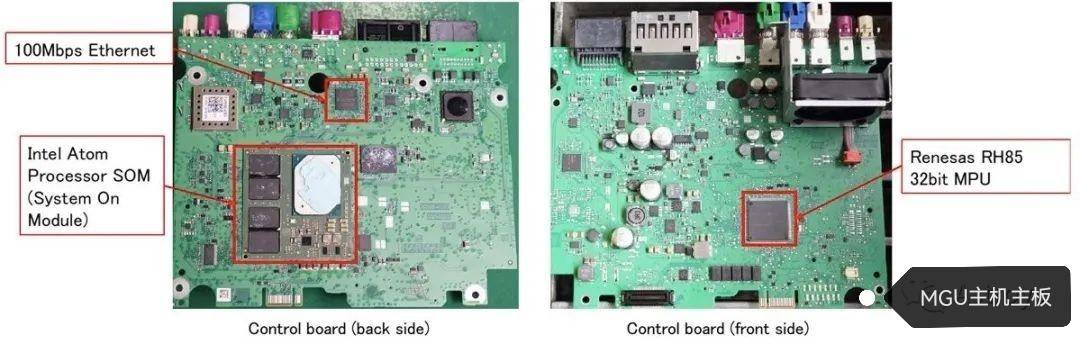
The chips on the HUH3 main board are almost unchanged from the NBT/EVO, it is still Intel's Atom and Renesas' RH850 MCU. This design retains the original design achievements and increases flexibility, which can be considered quite advanced, that is, the cost of the hardware has increased substantially.
The main processor on the MGU's control board is an Intel Atom, on which the BMW OS7 system is expected to run. The subprocessors on the main board are a Renesas MPU and a 100Mbps Ether Net Chip. 320Gbyte hard disk (HDD) with navigation map data is built into the MGU.
In addition to map data, music data can also be stored on the HDD from USB.
Well, verbose so much, you are not dizzy, a simple summary is that the host of the fifth generation of BMW MGU frame is the same as the entire system, the mainstream chip of the new host and EVO frame is not very different, the difference is that the host of the audio processing function through the Ethernet protocol to independent RAM module to deal with!
2.MGU Framework RAM Module (Receiver Audio Module)
Although the RAM module is called Audio Receiver Module, it has two motherboards builtin for navigation and audio, which are also supplied by Harman. This module is also supplied by Harman.
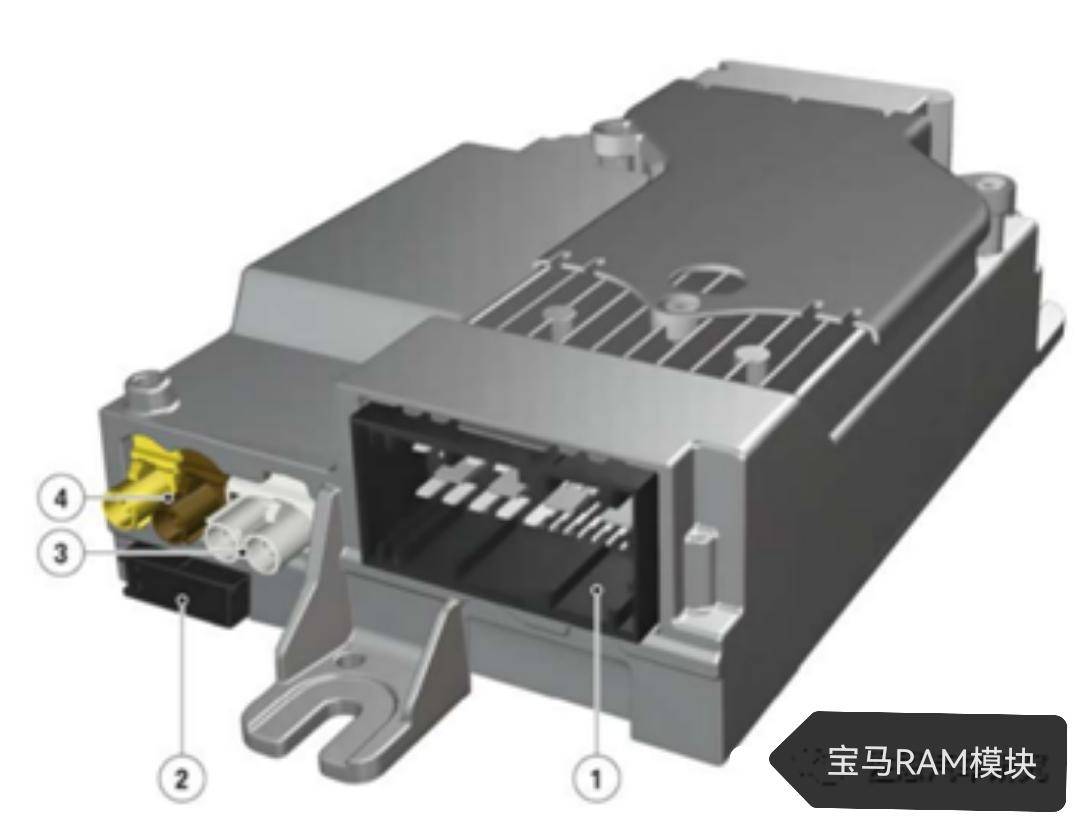
Let's start with a full view of the RAM module, where 3 and 4 are mainly AM/FM interfaces and 2 is the Ethernet interface.
Here's a disassembly to see the real thing.

As mentioned earlier, the module contains two motherboards, one is the navigation motherboard, in the upper part of the module; one is the audio motherboard, in the lower part of the module.
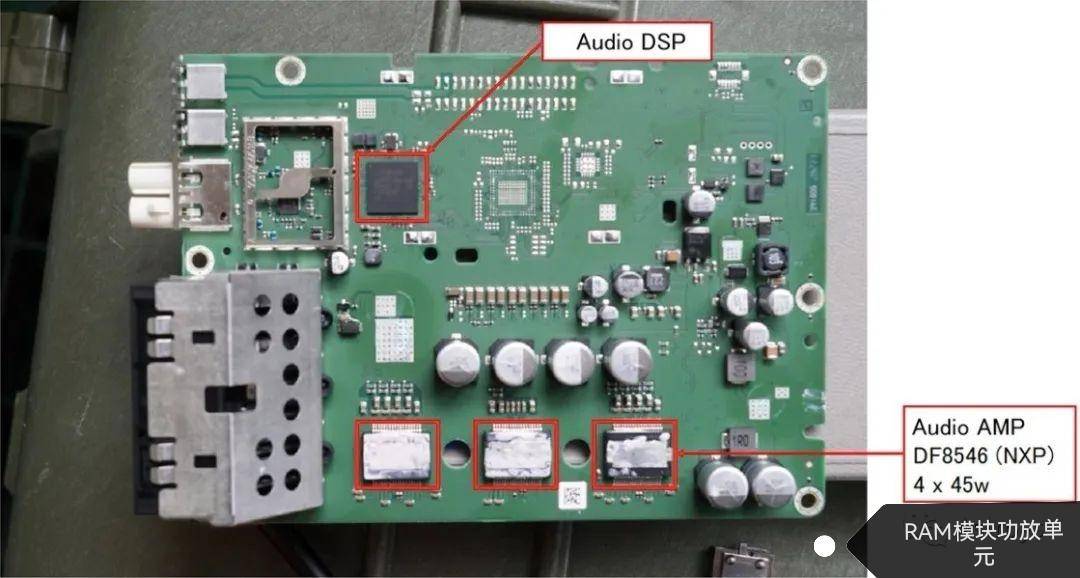
Audio motherboard mainly consists of two chips: DSP chip is used for digital slanders, that is, the socalled tuning, we set the host of high / low, equalization is the role of this chip. Amplifier chip is: NXP (NXP) 3 DF8546.
To ensure sound quality, BMW MGU using three NXP's TDF8546 power amplifier module, each module can output 4way 45 watts of audio power TDF8546 using high quality bridge pushpull BTL circuit, rather than the current mainstream Class D power amplifier, Class D power amplifier, although lowcost efficiency, but the sound quality of the hard and cold, real audiophiles will not agree with the sound of the D class. BTL Although the efficiency is slightly lower than class D, but the sound quality is far above the class D. This is exactly why BMW is still a luxury car. Is this why BMWs are still luxury cars? But, alas, more on that later.
To summarize the host and amplifier in the MGU frame, it can be said that it is a great improvement over the EVO frame, the amplifier is fully powerful and expandable.
3.MGU Architecture Horns
Before we talk about the MGU architecture, let's take a look at the EVO system.
The EVO system has a total of 4 audio configurations, which are stereo, hifi, Harman and BAUER. Harman and BAUER are connected by optical fiber, while the others are connected by normal wires.
Introducing the sound system diagram.
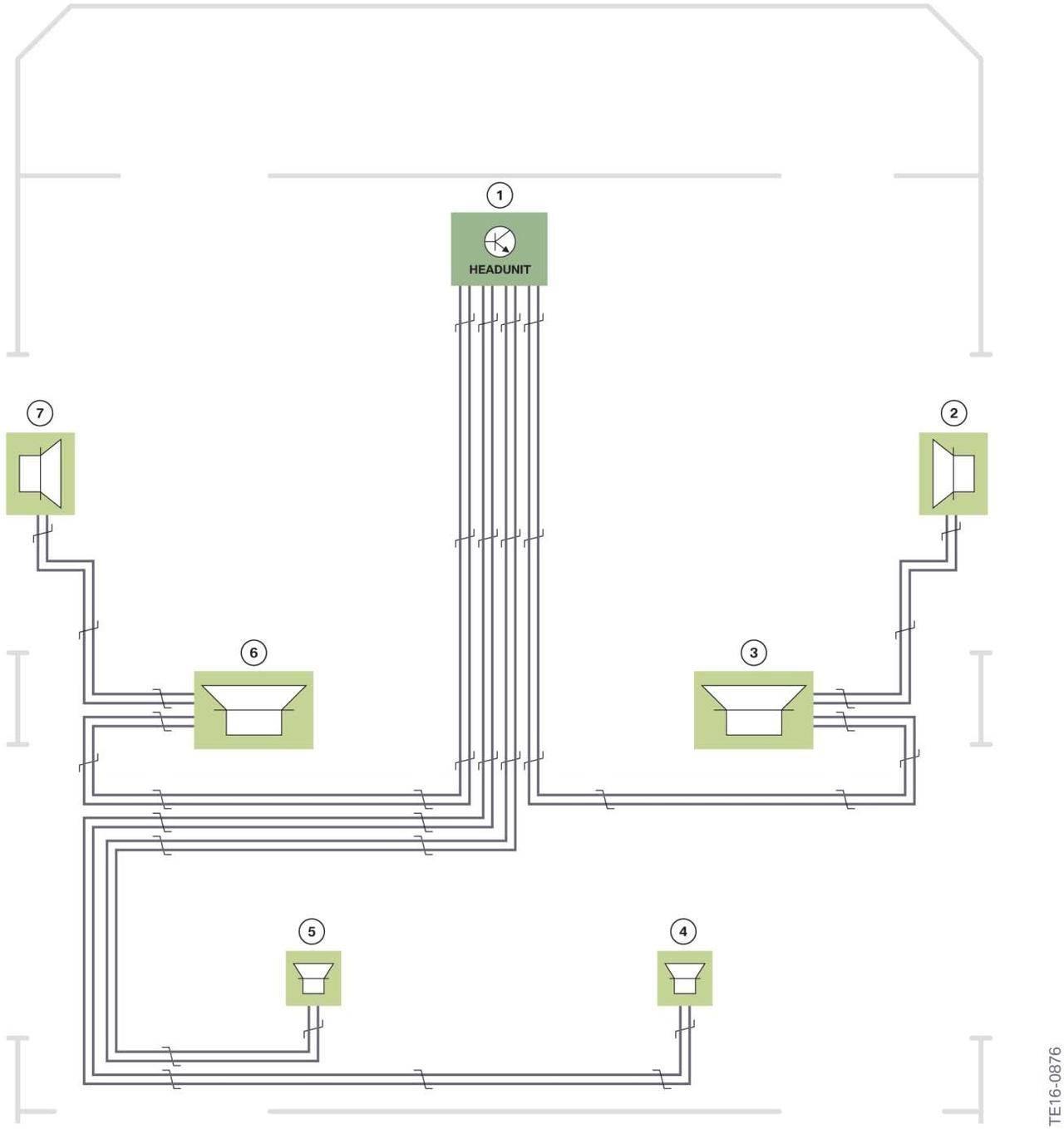
This is the standard stereo, you can see that the host has a total of four outputs, including the front door midrange and seat subwoofer in parallel, the rear object plate midrange is a separate output. The socalled 100 watts is estimated to be 15 watts for each midrange and 20 watts for each subwoofer.

This is a hifi system, the host is also four outputs to the hifi amplifier, in the hifi amplifier a total of seven outputs, respectively, the seat bass twoway, the front door side of a high and a middle in parallel with twoway, the center of a high and a middle in parallel with a way, the rear of a high and a middle on one side of the plate in parallel with twoway.
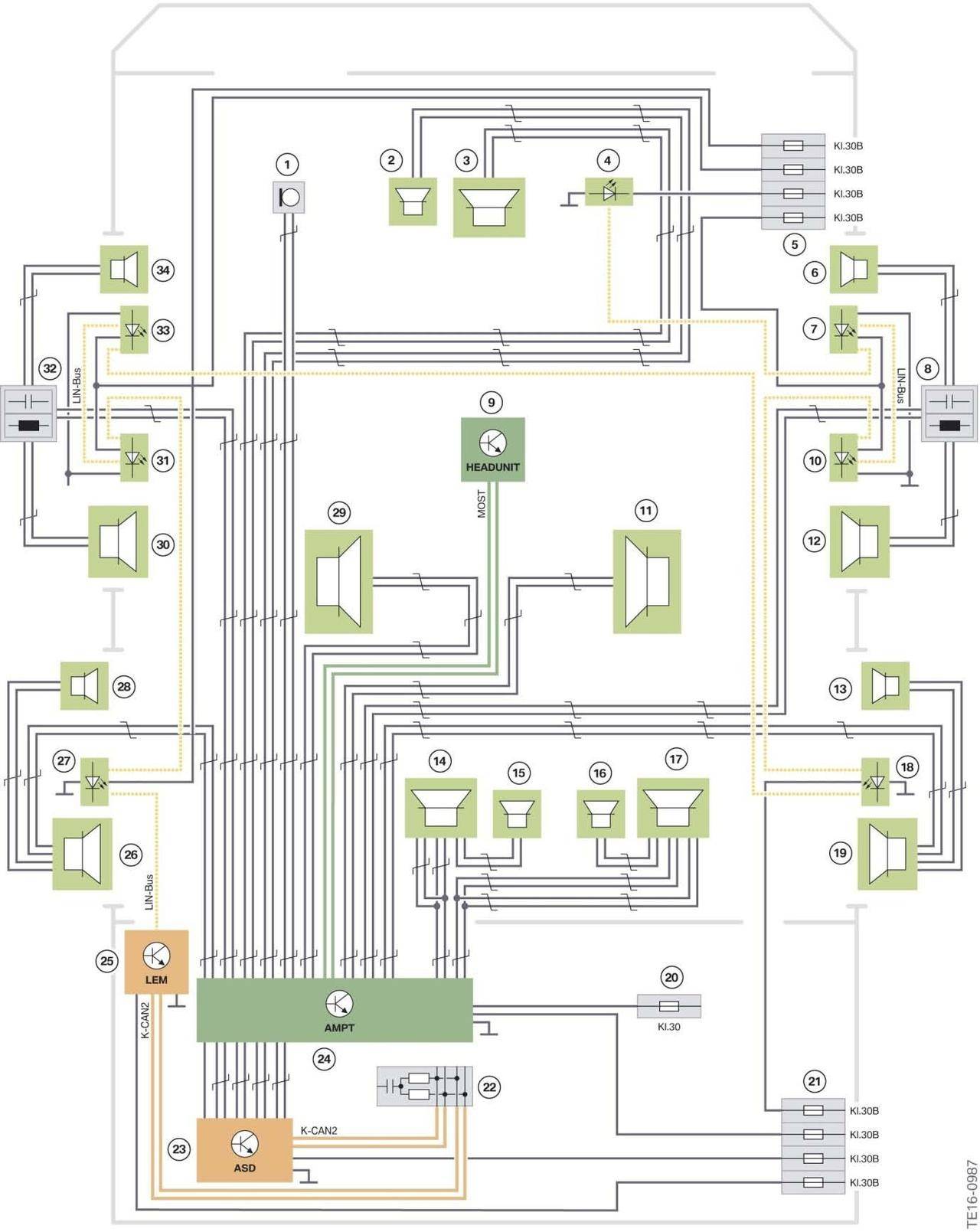
This is the Harman system, the host only fiber to the Harman amplifier, and then the Harman amplifier has nine outputs, that is, on the basis of high fidelity to increase the rear door side of a high one in parallel with twoway.
This is the BAUER system, compared to the Harman system, in addition to more BAUER cover led light output, but also more front door inductance capacitance crossover, BMW called this for the socalled active crossover, in fact it is very obvious that this is passive.
Well, here is not a little dizzy again, come we look at the MGU framed sound system diagram.
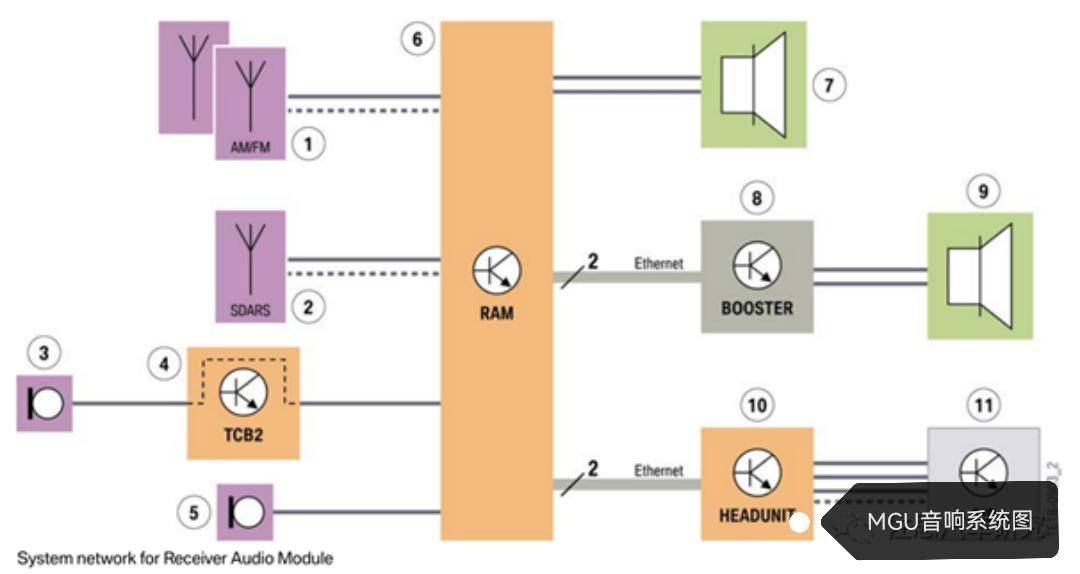
Is not clear, haha. Very clear ah. The host computer sends the ram module via Ethernet (the whole system is Ethernet protocol).
Then the hifi system is directly with ram to drive the speakers in the car, Harman and BAUER are driven by ram via Ethernet to the booster (8 in the picture) to drive the two subwoofers.
So the MGU architecture actually has three versions of its sound system.
The standard version (SA676) has 205 watts of power and consists of 3 tweeters, 5 midrange units and 2 woofers.
The Intermediate version (SA688) is Harman Kardon Surround Sound with 464 watts of power, including 5 tweeters, 5 midrange, and 2 woofers.
The Premium version (SA6F1) is Bowers&Wilkins Diamond Surround Sound with 1200 watts of power, including 7 tweeters, 7 midrange, and 2 woofers.
You may be wondering here, doesn't BMW only have 6 speakers in the lowest trim? Well, yes, I'm also wondering why BMW only gives 6 speakers when there are 12 45watt amplifier outputs in the ram module, maybe it's because you know what I mean.
Well, it's time to summarize again, the audio under BMW MGU architecture is actually very expandable, especially the low end system, you can take the speakers that you saved because of cost. Plus, and the ram module is powerful enough so you can add branded aftermarket speakers to enhance the effect.
4. MGU Architecture Wires
BMW went crazy with Ethernet at all costs, probably hoping to streamline the wiring harness, cut costs on the wiring harness, and reduce the weight of the wiring harness. From this point on, for the lower models is definitely an addon. Because BMW uses Ethernet for one wire connection for the sound system, no matter what configuration, this greatly reduces the number of wires used for the lower models. Then again, for the higher trims, I still prefer MOST, which sounds high up, although there is not much difference between the two in terms of shielding against interference.
5.MGU Framingaudio Modification Program
With the above basics, I believe you have a general understanding of the audio. Analyze the BMW whole system, the host is very good, whether it is EVO, or the latest MGU, its attack and put module, absolutely enough, absolutely enough, absolutely enough. In fact, the BMW system of that barrel effect of the short board, in the horn, horn, horn.
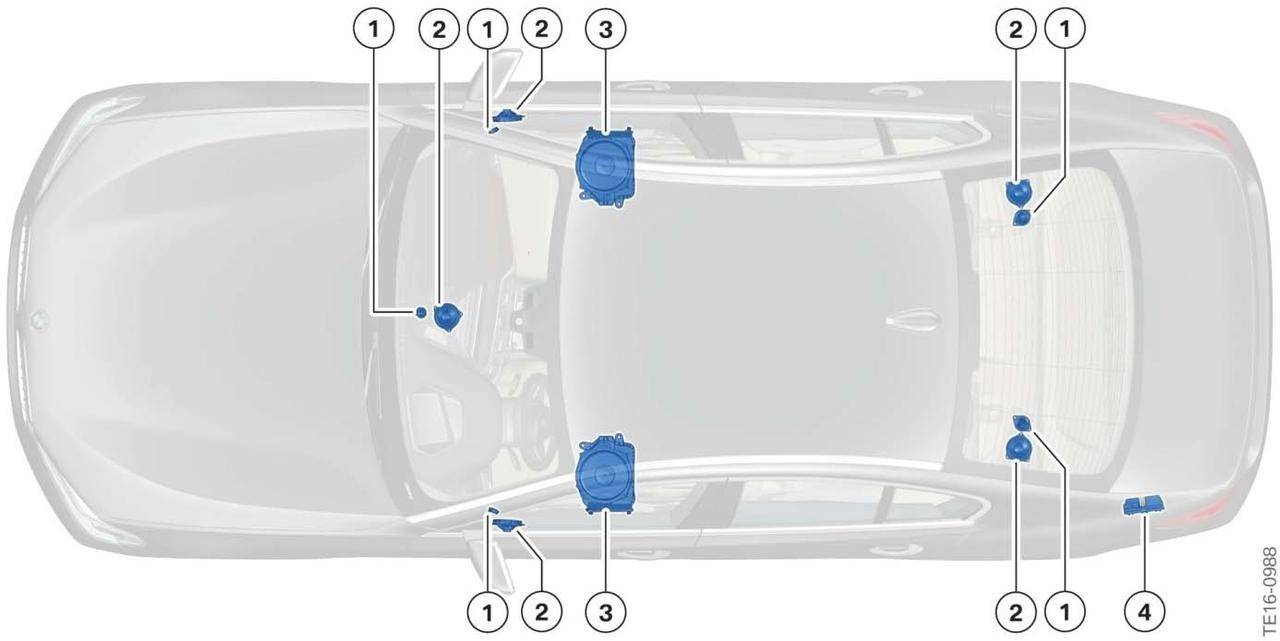
Almost all midlevel cars and above on the market can be simply upgraded in sound quality by replacing the speakers. The following EVO as an example (EVO can be used, MGU is even less so), a few brief explanations of the program:
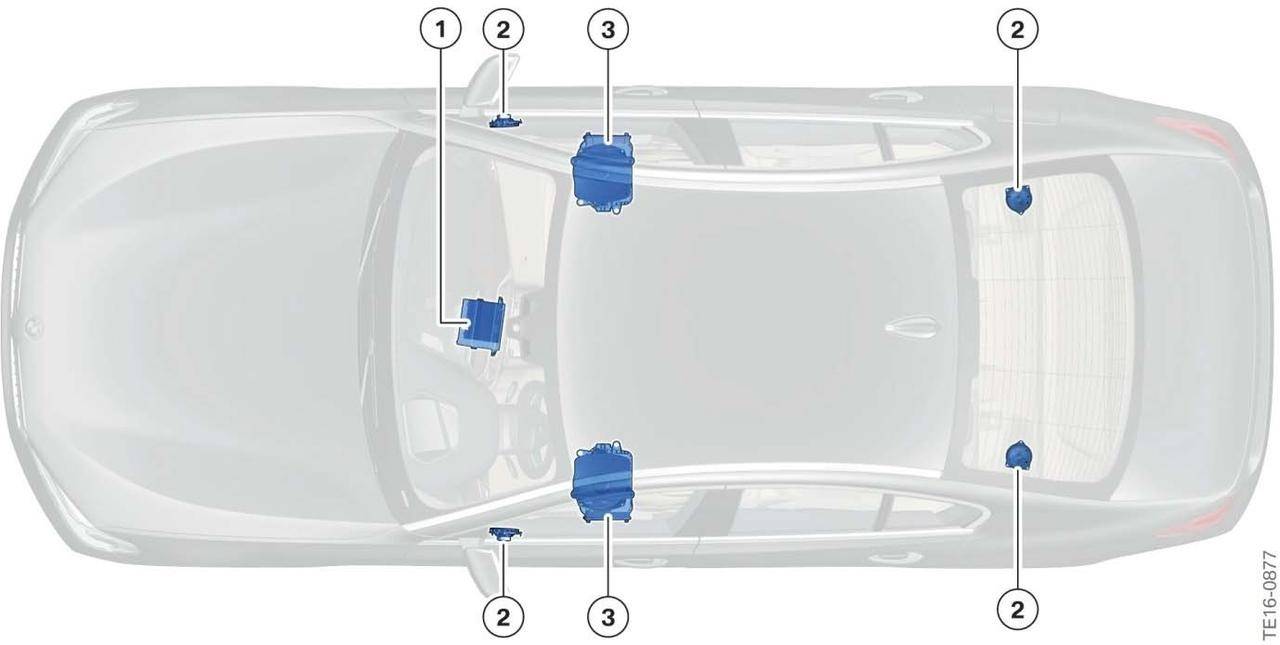
BMW stereo system, the original 6 speakers layout. For this system, the reason is simple, make up the simple matching treble, replace the original 6 speakers, so you can make up 10 speakers.
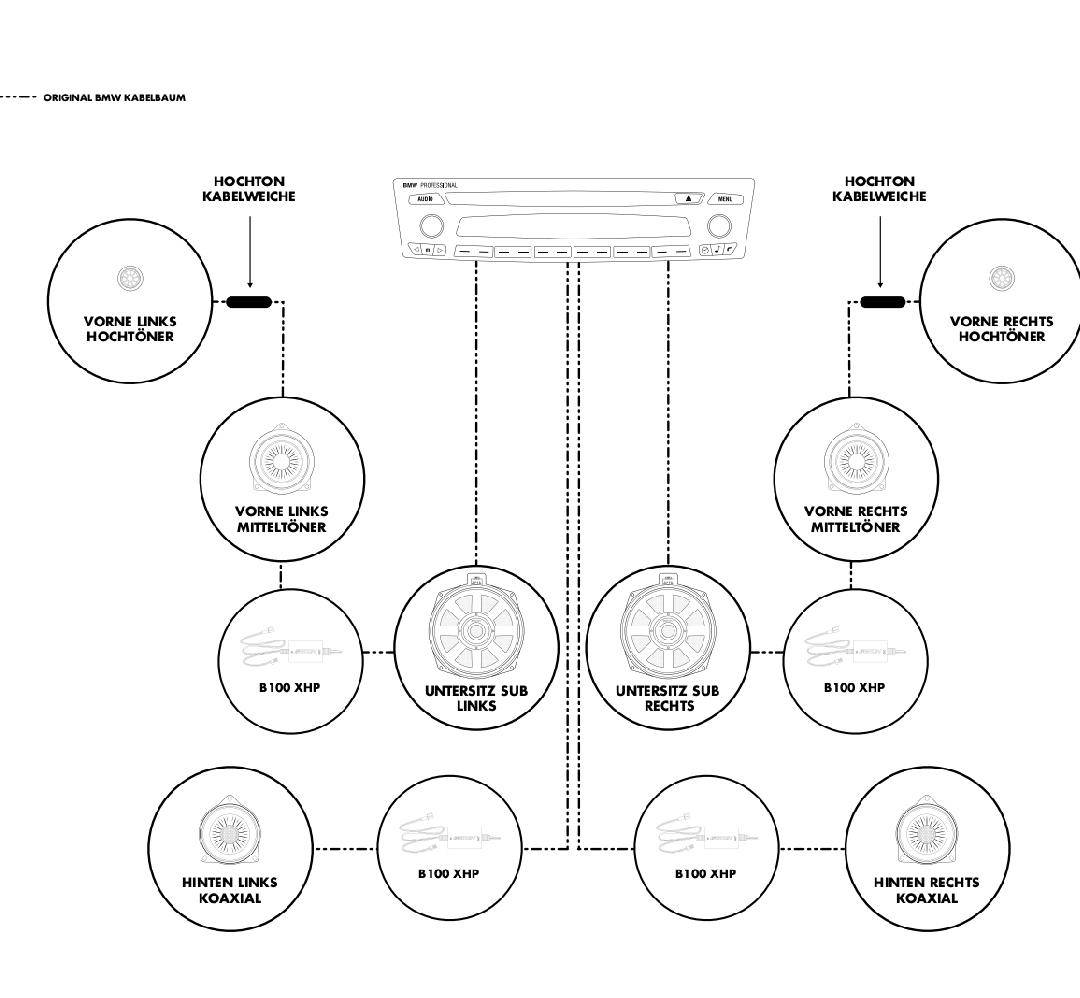
As shown in the figure, it should be noted that there is in the host or ram module and no crossover, especially for ev0 system, the front door midrange and bass is a line, so you must add a passive crossover for crossover.
Share:
Troubleshooting Turbo Boost Issues: Oil Leakage in BMW Engines
BMW 7 Series F02 headlight Issue Troubleshooting